
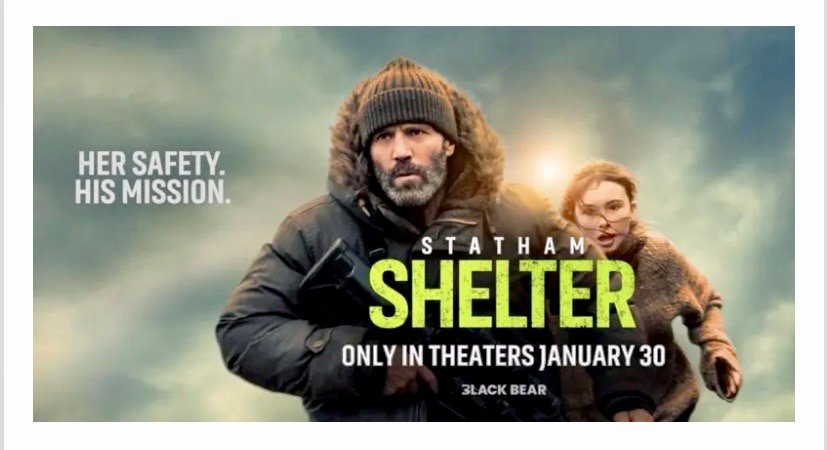
SHELTER
The action-thriller film Shelter, starring Jason Statham and directed by Ric Roman Waugh, is scheduled for theatrical release in Canada on January 30,2026. “A man running from his past must face it to protect a new friend.”
At the heart of the film, he must confront his buried past to protect her. built on playing
men who want quiet lives but carry dangerous histories. Construction worker.
Beekeeper. Mechanic. While the details shift, the core stays the same: a disciplined,
highly trained man, pulled back into violence by circumstance, loyalty, or conscience.
Yet in Shelter, Statham leans into this familiar archetype, letting more vulnerability
surface.
In this film, he appears as Mason. A former Special Forces operative, Mason has exiled
himself, living as a lighthouse keeper in the Scottish Hebrides. Within minutes, it’s clear:
Mason is not simply maintaining a light for passing ships. He lives by a strict routine, his
world silent except for isolation and his nameless dog. This solitude isn’t loneliness. It is
protection—survival.
That controlled existence shatters when Jessie arrives, a curious young girl who helps
deliver Mason’s weekly supplies with her uncle. Their early interactions are cautious,
restrained. Jessie is drawn to Mason and his quiet, mysterious act. Mason, for his part,
keeps his emotions and his distance. He’s determined to protect both his privacy and
the peace he’s carved out for himself.
A violent storm changes everything. Jessie nearly drowns. Mason reacts instinctively,
saving her—a moment that marks the film’s turning point. While helping her recover, he
unwittingly signals to forces that have been waiting for him to resurface. The world he
left behind has been watching. It has not forgotten.
After this, the story enters territory Statham fans will recognize: a betrayed soldier, a
corrupt superior, and a kill order that grows personal. Yet Shelter works due to its
restraint.
Bill Nighy delivers a very controlled menace as Manafort. The architect of Mason’s past
and the downfall of the life he left behind. He is not loud or theatrical, which makes him
more dangerous and outgoing. Naomi Ackie brings sharp authority as Roberta, the new
MI6 chief navigating an institution already compromised from within. Daniel Mays adds
grounded realism as Albert, a former ally who understands precisely what Mason is up
against. Harriet Walter appears briefly but effectively as a morally compromised prime
minister willing to support Manafort’s ruthless vision of control.
Director Ric Roman Waugh keeps the action tight and purposeful. Gunfights are
physical. Hand-to-hand combat, messy and exhausting—never stylized. A nightclub
shootout stands out; chaos and emotional stakes are balanced. Through it all, character
and consequences are never forgotten. Here, violence has weight. It always costs
something.
What ultimately separates Shelter from many action thrillers is the relationship between
Mason and Jessie. Bodhi Rae Breathnach delivers a beautifully measured and honest
performance. Her performance never looks or feels forced, and it avoids emotional
shortcuts and forced precocious dialogue. Through Jessie, Mason is gradually pulled out
of his emotional withdrawal. Initially distant and focused solely on survival, he begins to
reconnect, shifting his instincts from protecting only himself to caring for another—the
journey from isolation toward genuine connection. The connection between Mason and
Jessie, as it unfolds, makes a transformation that is both clear and believable. Her
presence allows Statham to soften without losing credibility. Their connection becomes
the film’s emotional anchor, grounding the story in responsibility rather than revenge,
and underscoring Mason’s complete transformation.
Shelter doesn’t try to reinvent the action genre. Instead, it makes the film feel a bit
more human. Shelter makes this work through disciplined action and genuine emotional
stakes. The film pushes Statham into a quieter, more layered action hero. It reminds
the audience that strength isn’t only physical. It also means caring, protecting, and
risking everything for someone else.
In a crowded field of action films chasing scale and spectacle, Shelter stands out by
choosing restraint, character, and emotional consequence. And that choice makes all
the difference.