Review TIFF50: The Choral
“In a town shaped by despair and loss, music becomes its lifeline.” “A must-
see for those who love the united voices of choirs or choral singers.”
Nicholas Hytner’s The Choral screens as part of TIFF’s 50th anniversary lineup. The film
is set in 1916, during World War I, in the fictional Yorkshire town of Ramsden. The
story focuses on how a small community uses music to hold itself together while war
removes certainty, stability, and loved ones from daily life.
Ramsden is in a state of waiting. Ramsden’s men have left to serve their country or are
preparing to do so. Families wait for letters or news about their loved ones. Daily
routines continue. Children play. The factories operate. Social rules remain in place but
with an underlying uncertainty.
Production designer Peter Francis grounds every scene in this uneasy normalcy. Streets
look worn yet lived in. Homes feel truly occupied rather than staged, as grief and hope
sit quietly in the background.
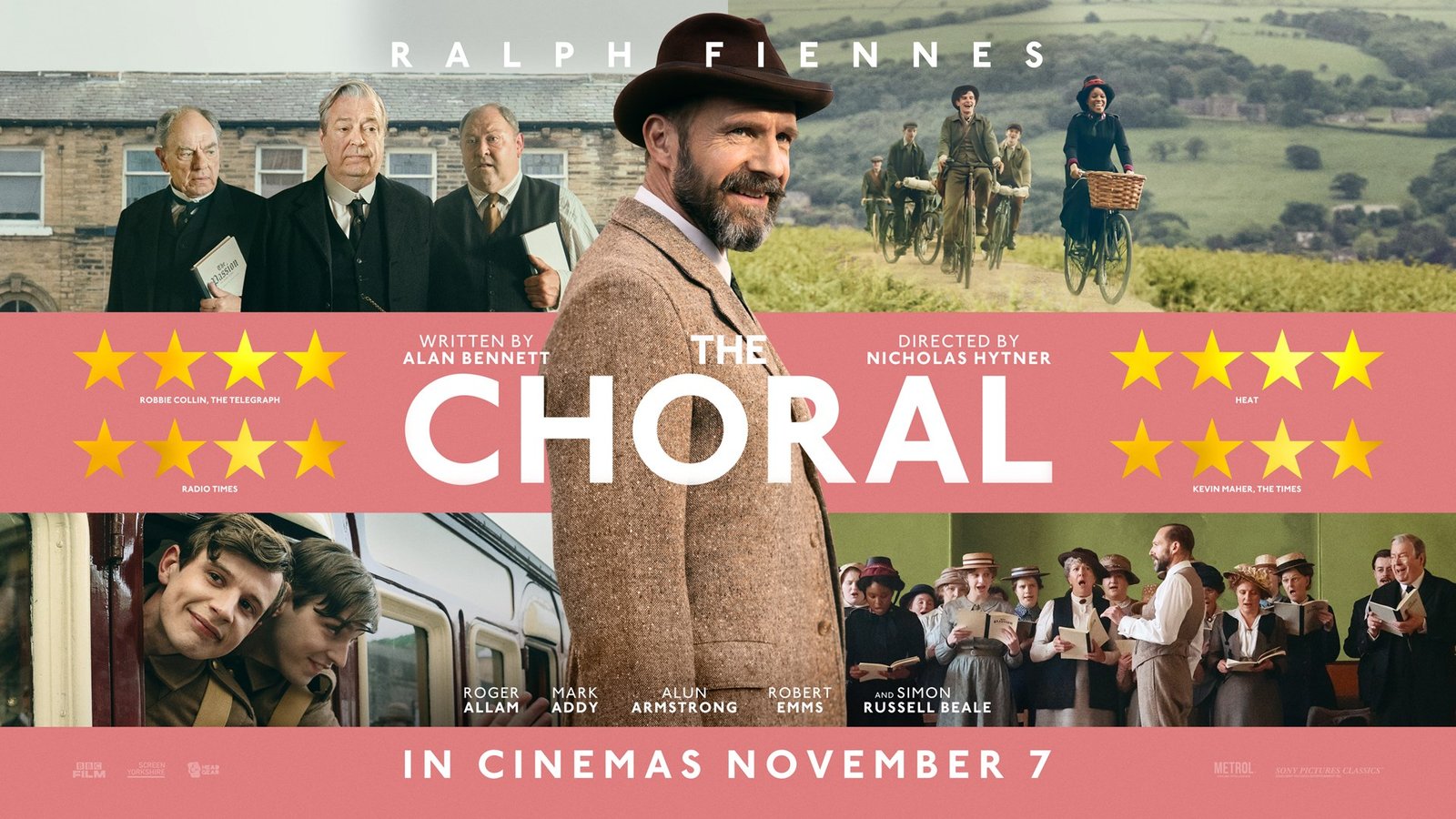
The story centres on the Ramsden Choral Society. Alderman Duxbury, played by Roger
Allam, and photographer Joe Flytton, played by Mark Addy, refuse to let the group
dissolve despite dwindling numbers who are currently serving in the war. When the
choir loses its conductor to the war. The choral committee members reluctantly hire Dr.
Henry Guthrie. Guthrie, who Ralph Fiennes brilliantly plays. His arrival is not popular or
unanimous. Guthrie, who has lived in Germany for years, raises concerns among the
choral members and the committee.
Fiennes delivers a controlled but excellent performance. Guthrie sometimes impatiently
listens and corrects, but mainly he protects the musical work. Guthrie firmly focused on
the performance as a collective effort, rather than an individual triumph of the choral.
His sexuality is in question. This places him further outside accepted norms, also
keeping him outside.
One key decision reshapes the story. Guthrie welcomes anyone who can sing to the
choral. Soldiers, labourers, and social outsiders turn out for rehearsals. The choral
community members go outside their usual repertoire by choosing Edward Elgar’s The
Dream of Gerontius. The choice unsettles parts of the town because of religious
tensions. The film treats this conflict with restraint rather than confrontation.
Amara Okereke as Mary, a Salvation Army volunteer, provides beautiful female vocals.
Her singing offers the film’s most affecting moments. Jacob Dudman as Clyde, a
wounded soldier who has a perfect singing voice.
The strongest emotional presence in the film belongs to the women of the choir,
especially Amara Okereke as Mary. Emily Fairn, who plays Bella, also stood out. Bella is
a young woman caught between loyalty to her beau, who’s missing in action, and an
uncertain future. The script limits the female characters by tying their personal arcs too
closely to those of their male counterparts.
Cinematography by Mike Eley avoids static staging. The camera moves fluidly
throughout the film. Moving wartime drama about community, courage, and the power
of song. The music and performance, even with its heavy topic, feel alive. A chorus of
grief, resilience, and shared humanity.
The Choral does not reshape history or the events of the war, and doesn’t need to. The
film celebrates the art as an act of endurance rather than escape. Music offers
structure, connection, and dignity. The audience leaves with a quiet joy and an
ensemble drama with heart and purpose. Music doesn’t stop war, but it keeps the soul
alive.