Review: Primate
“A tropical trip becomes a raw struggle for survival as nature turns deadly.”
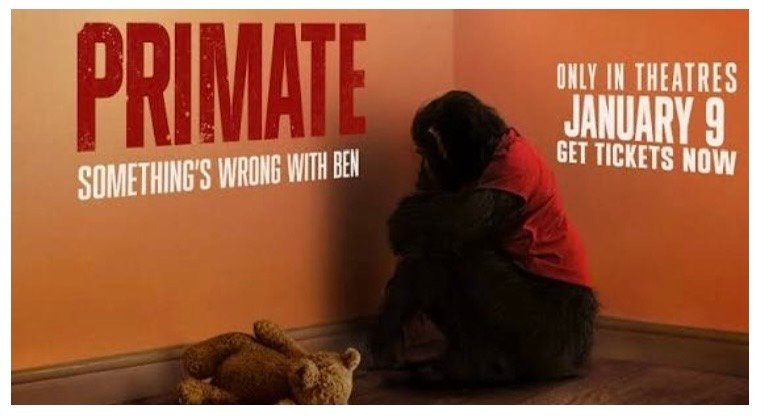
Primate is a horror film directed by Johannes Roberts. Johannes Roberts also co-wrote
the script with Ernest Riera. It received a wide theatrical release on January 9, 2026.
The film stars Johnny Sequoyah, Jessica Alexander, and Troy Kotsur. Sequoyah plays
Lucy, a young woman who returns with friends and takes them to a family home for a
tropical vacation. The family owns a pet chimpanzee named Ben. Ben contracts rabies
from an animal bite and becomes violent.
What Primate Is
Primate is a horror-thriller rooted in the creature-feature tradition. The film follows a
contained basic survival scenario. A family pet becomes the antagonist after illness
makes it dangerous. Reviews generally describe it as suspenseful and gory with
practical creature effects.
What Works
The core strength of Primate lies in its execution of horror elements. The direction in
each scene keeps the tension tight and focused. The pacing rarely slows down. The
suspense builds steadily as each event escalates.
The creature effects are apparent in their highlighting of the effectiveness of practical
effects. The creature work behind each effect gives the violent attacks physicality that
digital effects often lack.
Practical creature effects help establish physical danger. When Ben bursts through
windows or attacks characters, the scenes feel grounded.
A tropical home becomes claustrophobic as the characters find themselves trapped and
totally isolated from the rest of the world. This supports the story’s survival angle.
Intense individual scenes contribute to the film’s energy.
Performances anchor the narrative when the plot is simple. Troy Kotsur’s role as the
deaf father has featured prominently. The use of sign language is so uncommon in
mainstream horror. Significant for its visibility throughout.
The film’s technical elements work to support. Stephen Murphy’s cinematography and
Peter Gvozdas’s editing maintains clarity even during the film’s intense sequences.
Allowing the audience to follow the action without disorientation.
What Doesn’t Work
The plot developments are predictable for horror veterans. The film does not attempt to
deepen the characters beyond each of their basic survival needs.
Character development is limited. Many of the younger characters fit familiar horror
templates. Their motivations and backstories receive little to no exploration. Some
sequences play as straight horror, while others shift toward campy.
Practical effects receive praise overall. Unfortunately, the chimpanzee suit and
animatronics are inconsistent throughout the film. Some scenes look strong, others less
convincing.
Comparison
Primate fits within a long line of animal-based horror films. Works like Cujo in its
description of its premise. Cujo is a 1983 film about a rabid dog terrorizing a mother
and her son. Based on a Stephen King novel of the same name.
Verdict
If you are a true fan of horror films with straightforward premises, tension, and creature
effects, and practical design, Primate truly delivers.
If you prioritize deep character arcs or narrative complexity, Primate may feel limited.
Critics note the simplicity of the plot and the archetypal characters.
You can expect violence and unsettling scenes. Primate is not a thriller aimed at offering
light thrills. It leans into the entirely physical horror and survival metric.
Conclusion
Primate stands as a capable horror feature, with strong practical effects, and maintains
a consistent pacing.
The film works best as a horror experience, driven by survival and creature terror. It
does not aim for narrative depth or dramatic complexity.
Your decision to see it should reflect your tolerance for graphic horror and your interest
in creature-driven suspense. As a horror fan, which I can honestly admit I am not, this
film took me deep into the depths without any life-saving equipment. LOL! “Fear goes
wild when the chimp in charge becomes the threat.”