
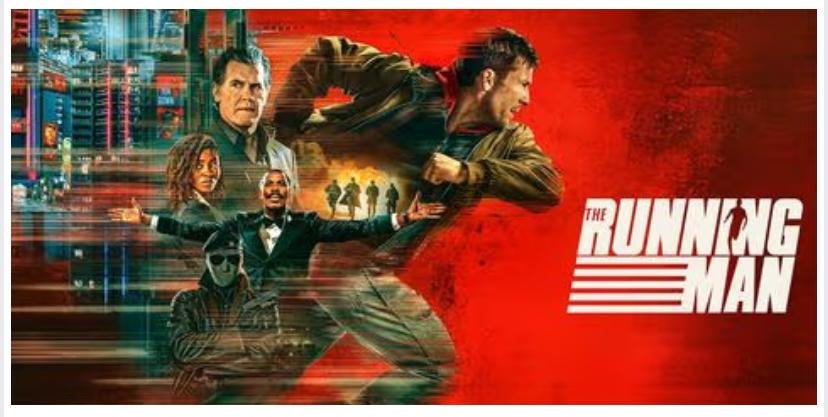
Review of The Running Man (2025)
Review – The Running Man (2025)! In Theatres on November 14, 2025. “Run
fast. Die live.”
Edgar Wright’s The Running Man reboots the survival-game spectacle with high energy,
striking visuals, and a timely sting, though it doesn’t always land as sharply as it aims
to. Based on the novel The Running Man, a novel by Stephen King (written under the
pseudonym Richard Bachman in 1982). However, this version sprints into a dystopia
that feels dangerously close to reality.
At the world premiere, Wright himself told the Canadian audience to “watch out for the
Canadian flag,” which indeed flashes by during a chaotic chase scene, a cheeky nod
that drew cheers.
The Setup
We meet Ben Richards (played by Glen Powell), a working-class man in a future
America where the corporate media machine owns everything, including the White
House, and poverty is a full-time condition for the have-nots. When his young daughter
falls ill and the system fails her, he signs up for the ruthless reality TV death-match
known as The Running Man. The deal? Stay alive for thirty days while being hunted by
celebrity assassins, drones, and even civilians chasing a cash bounty. The prize: a
billion dollars and freedom.
Powell gives Richards both grit and vulnerability — a blue-collar hero pushed to the
edge.
Wright assembles a powerhouse ensemble that keeps The Running Man pulsing with
personality, danger, and grit.
Glen Powell is Ben Richards. He brings the right balance of charisma, truth, and raw
desperation to protect his family and people like them. He’s no muscle-bound action
figure. He’s just a man crushed by a broken system, who’s not just fighting for survival,
but for truth. Powell carries the emotional core of the film, giving us a hero who’s both
haunted and human.
Josh Brolin delivers a chilling performance as Dan Killian. The calculating media
executive who treats people, life, and death as entertainment, just another product
launch. He’s calm, confident, and terrifying, a perfect embodiment of the film’s
corporate cynicism villain. Just don’t trust that smile.
Colman Domingo is magnetic as Bobby Thompson, the slick and sinister game show
host who turns cruelty into a theatrical spectacle. With his velvet voice and too-perfect
smile, Domingo commands every scene, playing the audience as masterfully as he plays
his victims. Colman was born to play this character.
Daniel Ezra shines as Marcus Lane, a rebel hacker working to expose the system and
the truth. His performance adds heart and idealism to a story that is otherwise
dominated by spectacle.
Michael Cera, cast deliciously against type, plays a man seeking justice for his father
and family. An ally when Ben needed someone on his side.
Lee Pace brings gravitas and moral ambiguity to the role of the government liaison,
pulling strings from the shadows as a hunter. A hunter who is very good at his job.
William H. Macy appears as a weary undergrown supplier who is a friend of Ben. He
helps Ben a little and sends him on his way, not wanting to get involved.
Jayme Lawson plays Ben’s wife, and one of the reasons he joined the Running Man
show. Provide a sense of security for his wife and sick child.
Emilia Jones enters when Ben hijacks her car, and she now becomes part of the
show. Like most viewers, she sees Ben as the monster. Together, they make The
Running Man more than a dystopian chase.
Wright directs the setup with kinetic flair — whip-fast cuts, pounding synth beats from
Steven Price’s score, and that signature Edgar Wright rhythm that makes chaos dance
in time.
What Works
Powell anchors the movie with sweaty determination and emotional heft. He brings a
mix of desperation and moral conviction, making you care even as the neon lights and
blood spray threaten to swallow him. Comer’s performance adds warmth and
conscience — she’s the mirror the audience needs when the film edges into madness.
Wright’s early sequences are wild and propulsive — reality-TV excess meets dystopian
satire. The first big chase (set in a crumbling Toronto turned entertainment district) is
jaw-dropping. And yes, that Canadian flag cameo lands perfectly.
Colman Domingo is electric — the kind of villain who makes evil look seductive. His
scenes feel improvised and deliciously cruel, the audience eating out of his hand.
Meanwhile, Brolin’s icy composure gives the chaos structure, while Elordi brings style
and swagger to a younger, faster generation of killers.
The world-building is top-tier: corporate-owned cities, social media cults, propaganda
loops, and drones replacing police. The set design combines retro-futurism and
corporate decay — think Blade Runner meets Black Mirror, with neon signage shouting
at you to buy, watch, and consume.
One reviewer summed it up best: “Wright takes that line and runs with it – at full sprint,
grinning, bleeding, and jabbing us in the ribs the whole way.”
Where It Stumbles
With all the style, the film doesn’t stick every landing. Some critics argue that Wright’s
signature spark feels slightly muted, perhaps lost beneath the scale of the spectacle.
The script juggles too many characters at once, leaving a few underdeveloped. Comer’s
arc, while promising, feels clipped; DeBose’s backstory screams for more time.
The pacing also wobbles in the middle stretch, as the satire gives way to large-scale
CGI mayhem. The social commentary, initially sharp, occasionally blunts under the din
of explosions and gunfire. The tone flips between dark comedy, social critique, and
blockbuster bombast without always finding balance.
As one critic noted, “If you didn’t know Wright had directed it, you might not know it
was his.”
Still, even when the rhythm slips, the film’s pulse never dies.
Why It Still Matters
In a time when we willingly turn real suffering into viral clips and “content,” The
Running Man hits closer than expected. Wright’s version doesn’t just ask what we’d do
for fame — it asks what we’d watch others do for it. The line between audience and
participant blurs fast.
Beneath all the film’s spectacle lies a human yearning for justice. A reminder of the
desensitized, addicted to our screens, as we cheer as others fall. That moral tension
keeps the film alive even when the editing turns frantic.
Final Verdict
The Running Man (2025) is part action-thriller, part dark satire, and all energy. It’s not
Edgar Wright’s sharpest work, but Baby Driver still holds that crown, and it’s easily one
of his boldest swings. Glen Powell proves himself as a leading man, carrying both
charisma and conscience. Domingo is hypnotic. Comer gives heart. And Wright keeps
the camera moving like he’s chasing the finish line himself.
If you go in for a spectacle, you’ll leave entertained. If you hoped for Wright’s signature
wit and emotional depth, you might wish he’d slowed down long enough to breathe.
Still, when the lights dim and that countdown begins, it’s hard not to lean forward.
Rating: 7/10: high-octane, visually thrilling, and thematically timely, even if
the magic fades at the edges.
When you catch it on the big screen, remember: the game is survival, the prize is truth
— and sometimes, the only way to win is to stop running. “When the lights come
on, the hunt begins.”