
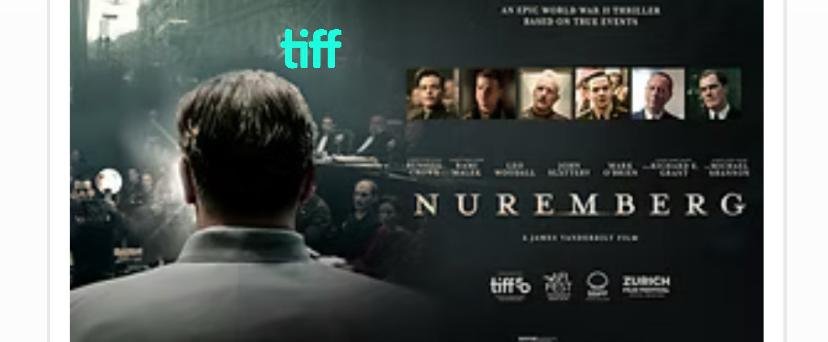
Review – Nuremberg
“The war is over. The reckoning has begun.”
James Vanderbilt’s Nuremberg is the kind of historical drama that grabs you by the
collar without ever raising its voice. It’s restrained, sharp, and quietly devastating. The
film doesn’t just re-create a moment in history; it interrogates it. Vanderbilt crafts a
story that asks one of the most uncomfortable questions imaginable: What makes a
person capable of evil? It’s a question that doesn’t have a clean answer. This film leans
into that ambiguity with chilling, clear precision.
Based on Jack El-Hai’s book The Nazi and the Psychiatrist, the film follows U.S. Army
psychiatrist Lt. Col. Douglas Kelley, played with tightly bottled intensity by Rami Malek.
Malek excels at characters who live in their own heads, and here he’s given a role that
lets him explore obsession, fear, and intellectual arrogance. Kelley is tasked with a job
that feels impossible: to evaluate the mental fitness of the top Nazi leaders before the
Nuremberg Trials. And among those men, one stands larger than life: Hermann Göring,
portrayed by Russell Crowe in what is easily one of the best performances of his career
in years.
Crowe’s Göring is not the caricature history books sometimes reduce him to. He’s
cunning, charismatic in a frightening way, and absolutely aware of his own power, even
in captivity. Crowe plays him with a sly confidence, a man who knows exactly how to
perform for an audience and exactly how to corner his opponent psychologically. This is
where the film becomes its most gripping: the long, quiet, loaded conversations
between Kelley and Göring. What starts as clinical interviews gradually transforms into
a high-stakes psychological duel. You feel the shift, the blurring of roles. Göring’s
manipulations start slipping under Kelley’s skin, and Kelley’s objectivity starts to crack.
It’s fascinating and unsettling watching a psychiatrist begin to lose control of the very
dynamic he’s trained to command.
But the film is not just a two-hander. Michael Shannon steps into the role of Chief
Prosecutor Robert H. Jackson and gives the film its moral backbone. Shannon plays
Jackson with a heavy, almost grieving kind of authority, a man who understands that
he’s not just building a legal case, but the foundation for how the world will judge evil
from this point forward. He brings an emotional weight that grounds the film. Whenever
he steps into frame, you feel the seriousness of the moment. His scenes balance the
eerie intimacy of Kelley and Göring’s psychological wrestling match.
The supporting cast, including Leo Woodall, Richard E. Grant, and Colin Hanks, rounds
out the ensemble with strong, grounded performances. They add texture to a story that
could’ve easily become too cold or too academic. Instead, it feels human. You sense the
exhaustion of a world trying to make sense of itself after witnessing the worst of
humanity.
Vanderbilt’s direction is one of the film’s quiet triumphs. He avoids sensationalism
entirely. There are no flashbacks to atrocities, no big courtroom outbursts, no
Hollywood-style grandstanding. Instead, he builds tension through stillness. Through
stark rooms, long silences, the sound of a pencil tapping against a metal table, a
lingering stare that lasts one second too long. He trusts the audience to lean in rather
than be pushed. The horror of what happened during the war is present in every frame,
but it’s never shown. It doesn’t have to be. The weight of it sits in the air like smoke
you can’t get out of your lungs.
The cinematography matches this tone perfectly. Post-war Germany is rendered in
muted shades, greys, browns, and washed-out blues. The world looks like it’s been
drained of life but is trying, desperately, to recover some trace of moral color. Every
shadow feels like a reminder of something that can not be undone. The visual language
reinforces the film’s central tension: the world is searching for justice, but the answers
are murky, and the people delivering justice aren’t always standing on excellent ground
themselves.
What makes Nuremberg so powerful is its honesty. It doesn’t pretend that justice is
neat. It doesn’t pretend that evil is easy to understand. Instead, it shows how fragile
conscience can be, how easily one person’s charisma or confidence can distort another
person’s moral compass. Kelley’s gradual fascination with Göring is not presented as
some dramatic reversal, but as a subtle erosion. That’s what makes it frightening. Evil
doesn’t shout. Sometimes, it charms.
By the end of the film, you’re left with questions that don’t resolve neatly. Did Kelley
get too close? Was Göring manipulating him, or was Kelley already vulnerable to a man
like him? What does it mean to judge people capable of atrocities when the line
between sanity and madness is almost impossible to draw? And perhaps the biggest
question of all: if these men were human, flawed, broken, monstrous, but human. Then
what does that say about the potential within the rest of us?
Nuremberg is not just a courtroom drama. It’s a moral reckoning. It asks you to sit with
discomfort, to acknowledge how slippery the human mind can be, and how quickly
empathy can turn into something dangerous when pointed in the wrong direction. The
film lingers long after the credits roll, not because of significant emotional moments,
but because of the quieter truths it refuses to let you ignore.
Powerful. Haunting. Necessary.
“Nuremberg: Where justice met the unimaginable.”