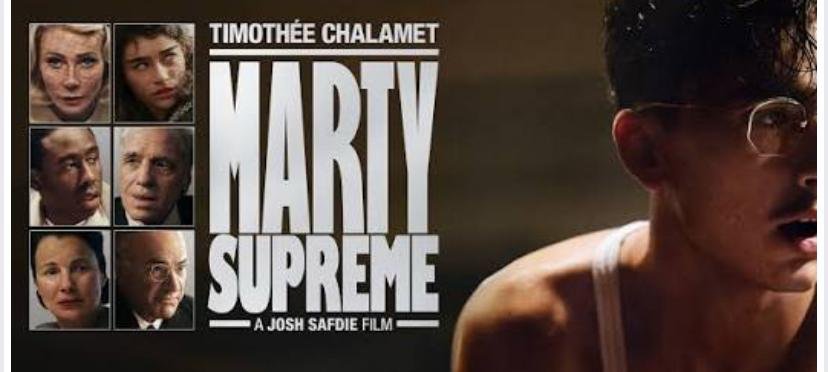
Review – Marty Supreme (2025)
Directed by Josh Safdie | Starring Timothée Chalamet, Gwyneth Paltrow,
Odessa A’zion, Tyler, The Creator, Fran Drescher, Kevin O’Leary, Abel Ferrara,
Sandra Bernhard, Tracy McGrady, Koto Kawaguchi
Every year, there are a few films that sneak up on you. It’s funny, messy, bold,
heartfelt, and somehow exactly the thing you didn’t know you needed. For TIFF 2025,
Marty Supreme is that film. Josh Safdie’s chaotic, kinetic, strangely tender sports
dramedy takes something as unassuming as 1950s table tennis and turns it into
something else entirely. It turns it into a full-blown underdog epic with the swagger of a
rock opera and the emotional pulse of a coming-of-age story. And at the center,
Timothée Chalamet, is doing some of the most charismatic and charming work of his
career.
Let me be clear: you do not need to know anything about ping-pong to fall in love with
Marty Supreme. You don’t even need to like ping-pong. You have to enjoy watching a
dreamer, someone who refuses to shrink, refuses to be reasonable, and refuses to be
small, try to turn an impossible passion into a legacy.
Timothée Chalamet as Marty Mauser: A Hustler, a Visionary, a Chaos Magnet
Chalamet plays Marty Mauser, a thin, stylish, endlessly confident ping-pong prodigy
who refuses to treat table tennis as a “basement hobby.” No, for Marty, this is
showmanship. This is culture. This is destiny. He wants fans. He wants lights. He wants
cigarette ads, packed arenas, and the kind of glitzy marketing that boxing, baseball,
and post-war American showbiz had in their veins.
The film may be fictionalized, but the spirit comes straight from the real-life Marty
Reisman, who hustled ping-pong games in smoke-filled bars and reinvented the sport
long before anyone realized it needed reinventing. And Chalamet captures that
mischievous, magnetic hustler energy perfectly. He’s smooth. He’s cocky. He’s a
walking contradiction, half genius, half disaster waiting to happen, and Chalamet makes
the character shine without sanding down any of his rough edges.
It’s one of those roles where you can feel the actor having fun. And when the actor has
fun, we have fun.
Josh Safdie’s Wild, Stylized 1950s
Josh Safdie films don’t sit still. They vibrate. They rattle. They pulse with energy, and
Marty Supreme is no exception.
But what’s surprising here is how Safdie adapts his trademark chaos to the 1950s.
Instead of grimy streets and claustrophobic tension, he gives us bright neon, diners,
jazz clubs, smoky back rooms, and the growing commercialization of American sports.
His 1950s are equal parts nostalgia and satire, sleek and glamorous on the surface, but
full of hustlers, dreamers, sharks, and schemers underneath.
He shoots the ping-pong matches like boxing bouts. He films the conversations like
chess matches. He frames Marty like a rock star long before the world is ready to treat
him like one.
This is Safdie’s first period film, and you can feel him stretching his wings. It’s more
playful than Uncut Gems, more emotional than Good Time, but still unmistakably his.
The Ensemble: A Delicious Mix of Chaos and Comedy
The cast Josh Safdie assembled is so unexpected that it actually works.
Gwyneth Paltrow plays Marty’s mother with a perfect mix of elegance and
quiet panic, constantly smiling while wondering what on earth her son is doing
with his life.
Odessa A’zion brings fire, humour, and grounded realism as Marty’s girlfriend,
the only person who sees through his bravado and still roots for him.
Tyler, the Creator steals scenes as a flamboyant sports promoter who believes
in Marty one day and ditches him the next.
Fran Drescher is hilarious as a journalist who cannot believe she’s covering
ping-pong.
Kevin O’Leary, yes, “Mr. Wonderful,” is so perfectly cast as a ruthless 1950s
businessman that it feels like he time-travelled to be here.
Sandra Bernhard, Abel Ferrara, and Tracy McGrady bring the exact kind of
weird, delightful energy a Safdie film thrives on.
And Koto Kawaguchi plays the stern Japanese champion who becomes Marty’s
main rival, quiet but deadly, disciplined but compassionate.
It’s a cast you wouldn’t dream up unless someone dared you—but somehow they all fit.
The Heart of the Film: A Dream Too Big for the Time
At its core, Marty Supreme is a film about belief.
Believing in a sport that no one respects.
Believing in a talent that no one sees.
Believing in yourself when everyone keeps saying, “Why don’t you get a real job?”
Marty doesn’t want a real job. He wants to put ping-pong on the map.
The film shows the endless pushback he gets, from family, from business partners,
from the public, even from other athletes. To them, ping-pong is a party trick. A parlour
game. A toy.
To Marty? It’s the future.
This tension, between how the world sees him and how he sees himself, gives the film
its emotional weight. It’s funny, yes, but it’s also a story about ambition so big it almost
swallows him whole.
The Final Act: Pure Safdie Chaos
The third act is where the movie truly becomes a Safdie film.
Everything Marty has built, every promise, every gamble, every partnership, collapses
and explodes all at once. There’s a major tournament. There’s a scandal. There’s a
disastrous interview involving flamethrower-level honesty. There’s a sequence with
Marty hustling wealthy socialites in a penthouse that had my entire theatre buzzing.
It’s tense. It’s messy. It’s ridiculous.
But it’s also exhilarating.
And the ending, without spoiling, is oddly gentle. It’s about legacy, not victory. About
impact, not trophies. About how some people are ahead of their time… and the world
takes a minute to catch up.
Final Thoughts: A Wild, Warm, Wonderfully Messy Love Letter to Dreamers
Marty Supreme is not your typical sports movie. It’s not even a typical A24 movie. It’s a
loud, stylish, hilarious, deeply human celebration of weirdos, hustlers, and underdogs.
It’s about fighting for the thing you love, even when people laugh at you for loving it.
Timothée Chalamet? This performance is a turning point for him. Loose, funny,
irritating, lovable, impulsive, magnetic, he carries the film with such confidence that you
can’t help but root for Marty, even when he’s making the worst decisions imaginable.
Safdie gives us a story that’s chaotic but full of heart, messy but meaningful, nostalgic
but new.
And by the end, you believe Marty Mauser was right all along:
Ping-pong is a sport worth watching.
Dreams are worth chasing.
And legends start long before the world realizes they’re legends.
Marty Supreme is wild. It’s strange. It’s joyful.
And it’s absolutely worth the ride.