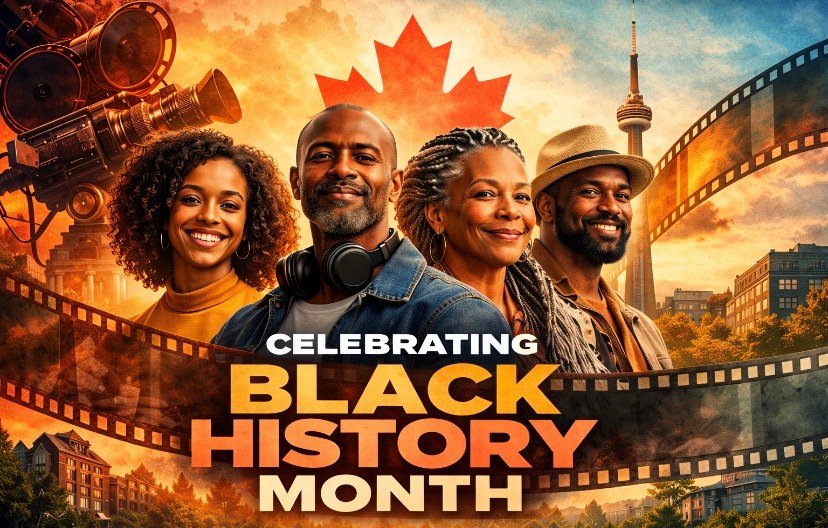
Celebrating Black Voices in Canadian Film for Black History Month
Black History Month in Canada offers an annual chance to honour Black storytelling in
cinema, and the country’s filmmakers, actors, and documentarians have crafted a
powerful body of work that reflects Black experiences across time and place. From
documentaries about forgotten histories to narrative features rooted in imagination and
identity, Black Canadian cinema continues to expand representation on screen and in
cultural conversations.
One foundational film in Black Canadian cinema is Honour Before Glory, a 2001
documentary-style feature from Anthony Sherwood that tells the story of the No. 2
Construction Battalion, Canada’s first all-Black military unit during the First World
War. Based on the diaries of Sherwood’s great-uncle, Reverend William A. White, the
film dramatizes the battalion’s struggles against systemic racism and structural barriers
while serving overseas. This work has become a staple during Black History Month,
cultural retrospectives, and Remembrance Day screenings, and is being preserved
through Telefilm Canada’s restoration initiatives.
Recent years have produced new works aiming to illuminate Black Canadian narratives
previously overlooked. Union Street (2023), directed by Jamila Pomeroy, documents
the history of Hogan’s Alley, a once-vibrant Black neighbourhood in Vancouver that was
razed in the early 1970s in the name of urban renewal. The film deeply examines
community loss and resilience and was honoured with a best director award at the
Reelworld Film Festival, before finding a renewed audience during Black History Month
screenings and streaming availability on TELUS platforms.
The 2025 documentary True North, directed by Michèle Stephenson, revisits the
1969 Sir George Williams affair in Montreal, when Haitian Canadian students
staged a protest against systemic racism at Sir George Williams University. The film
connects this pivotal protest to broader movements for change and expands on its
predecessor documentary, Ninth Floor, by situating the occupation within a larger
context of civil rights activism. True North premiered at the Toronto International Film
Festival and continues to spark discussion on race, justice, and collective memory in
Canada.
A standout, internationally acclaimed Canadian documentary is Any Other Way: The
Jackie Shane Story, directed by Michael Mabbott and Lucah Rosenberg-Lee. This
biographical film profiles Jackie Shane, a groundbreaking Black trans soul singer who
emerged in Toronto in the 1960s and pushed musical boundaries while challenging
social expectations. The documentary has won over 20 awards, including a Peabody
Award for Documentary, and retraces her career through interviews, archival
footage, and innovative storytelling. This resurgence of Jackie Shane’s legacy reflects
the film’s ability to both recover and celebrate a Black musical trailblazer.
Other Canadian documentaries contribute meaningfully to the national conversation on
race and identity. The Skin We’re In (2017), directed by Charles Officer and featuring
journalist Desmond Cole, documents the realities of systemic racism faced by Black
Canadians and earned recognition with a nomination for the Donald Brittain Award at
the Canadian Screen Awards. Dear Jackie (2021), directed by Henri Pardo, takes a
historical lens on Montreal’s relationship to baseball legend Jackie Robinson,
reframing local narratives about race and myth-making in Canadian cultural memory.
The North Star: Finding Black Mecca (2021) highlights Black Canadian communities in
Ontario, illustrating community self-determination and local civil rights legacies.
These films and documentaries exemplify the diversity of Black Canadian storytelling,
from historical rediscovery and community documentation to personal portraits of
resilience and creativity. They are complemented by Black actors, directors, producers,
and screenwriters working across the industry. Many Black Canadian performers and
creators, whether on screen, behind the camera, or in writing rooms, are featured on
resources such as the List of Black Canadians, which includes actors, directors, and
film industry professionals who contribute to Canada’s cultural landscape.
As schools, festivals, and cultural organizations curate special screenings and
discussions throughout February, Black History Month in Canada becomes a moment to
look back at stories too often sidelined, to celebrate achievements in narrative and
documentary film, and to support the next generation of Black Canadian voices who will
shape cinema for years to come.
- Honouring Black Canadian stories on screen, past and present.
- Celebrating the filmmakers shaping Black Canadian cinema.
- From forgotten histories to bold new voices, Black stories take focus.
- Black Canadian film as memory, resistance, and creative power.
- Stories rooted in Canada, voices reaching far beyond its borders.