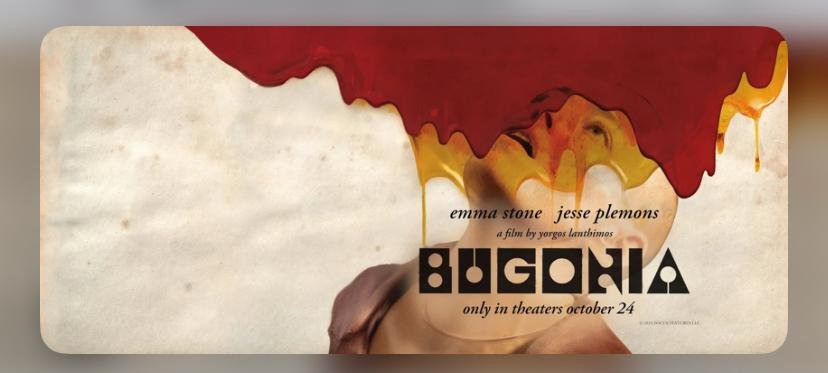
Bugonia
Bugonia: Humanity on Trial. “What if the real invasion is already in our
minds?”
“In Bugonia, the monster isn’t from space — it’s us.”
Is humankind worth saving? That question drives Yorgos Lanthimos’s black comedy
Bugonia, a wild, unsettling ride that plays like a mirror held up to modern madness.
Written by The Menu’s Will Tracy, the film blends absurdist humour with biting social
commentary, forcing audiences to face the disturbing logic of a world where conspiracy,
delusion, and moral decay collide.
The story begins when two small-town men, Teddy (Jesse Plemons) and his cousin Don
(Aidan Delbes), kidnap Michelle (Emma Stone), a high-profile pharmaceutical executive.
Teddy and Don are convinced she’s an alien sent to earth to manipulate humanity and
that her corporate empire is proof of her extraterrestrial control. Michelle denies it, but
Teddy’s mind is already too far gone. His house, covered in star charts and newspaper
clippings, looks like a shrine to paranoia. For him, every thread connects back to her,
and the buzzing of his backyard beehive feels like confirmation from another world.
Lanthimos uses that setup to explore how fear and misinformation twist human
perception. What starts as a hostage situation spirals into a bleakly funny reflection on
modern conspiracy culture. Teddy’s madness feels disturbingly familiar; his “evidence”
echoes the obsessive logic of online rabbit holes. Don, unsure but loyal, becomes the
film’s conscience, trapped between his cousin’s mania and Michelle’s unshakable calm.
The tension between reason and delusion gives Bugonia its charge. Stone’s
performance is sharp and composed, grounding the chaos around her. Plemons delivers
one of his best turns yet, his eyes flickering between rage and fragility. Delbes brings
quiet depth to Don, whose doubts become the audience’s own.
Visually, the film is hypnotic. Cinematographer Robbie Ryan shoots in VistaVision, giving
the images a warped intimacy that makes even ordinary spaces feel alien. Production
designer James Price and composer Jerskin Fendrix add to the sense of unease,
creating a world that looks familiar but feels completely off-balance.
Beneath the humour, Bugonia asks a larger question: when people stop believing in
truth, who becomes the monster? Lanthimos doesn’t offer comfort. The film strips away
illusion until what’s left is both funny and horrifying, the spectacle of human beings
clinging to madness as proof of meaning.
By the time the eclipse arrives, and the lines between sanity and delusion collapse,
Bugonia feels less like science fiction and more like a warning. It’s the most focused
and biting work Lanthimos has made since The Favourite, proving again that his best
weapon is absurdity used as truth.
Bugonia is a mirror. Look too long, and you might not like what looks back.