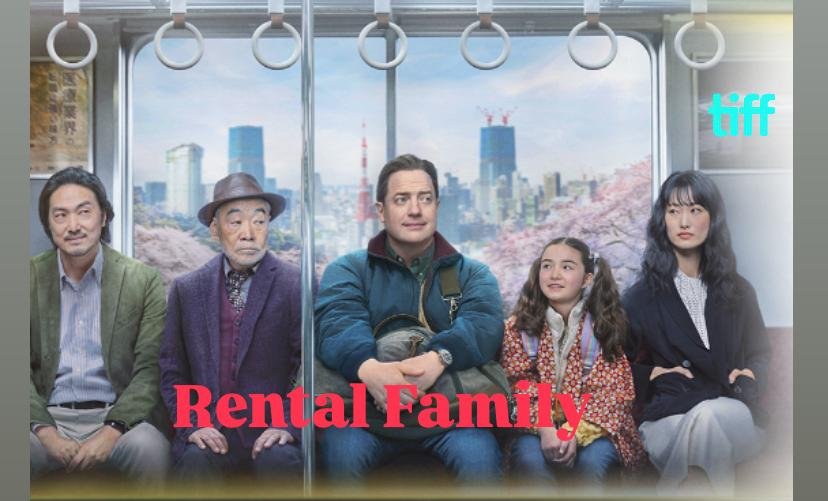
Rental Family
Rental Family — TIFF 50 “Sometimes the people you hire become the family
you need.”
If Rental Family were a song, it’d be a whisper in a crowded room, subtle, slow, and full
of longing. Directed by Hikari and starring the emotionally resonant Brendan Fraser,
the film premiered at TIFF 50, occupying that uneasy space between performance and
reality.
Fraser plays Philip Vandarploeug, an American actor adrift in Tokyo, whose loneliness
leads him to a strange job: playing roles in people’s lives. From a mourner at funerals to
a faux father, and even an actor-journalist for an aging filmmaker, Philip’s assignments
start as detached work but slowly pull him into the lives of the people he’s pretending
to care about. The lines blur. And Fraser? He carries it all with gentle sincerity, longing,
shame, awkwardness, and hope.
Visually, Rental Family captures Tokyo’s heartbeat. Neon lights, crowds, narrow alleys,
sprawling apartment windows. The city feels like both a refuge and a cage. Philip’s
loneliness is highlighted by shots where he’s small against the skyline, distant from life,
watching through windows. It’s beautiful but fragile. The score, by Jónsi and Alex
Somers, surrounds the emotion without overwhelming it; woodwinds, piano, and light
strings punctuate moments of silence. It allows you to feel what Philip doesn’t yet know
how to put into words.
Supporting characters add depth to the film’s heart. Shinji, played by Takehiro Hira, is
the CEO (Rental Family) who first hires Phillip, an American actor, into his unusual
business, which provides “rental” family members and companions to clients in need.
Initially impressed by Phillip’s performance at a fake funeral, Shinji offers him a job,
seeking a “token white guy” for specific roles. As Phillip becomes emotionally invested
in his work, Shinji’s detached professionalism creates a sharp moral contrast between
them, turning him into both a mentor and a catalyst for conflict as the film questions
the ethics of fabricated human connection.
Mari Yamamoto’s Aiko has a quiet bitterness shaped by her own “roles” in this
economy of affection. Akira Emoto’s performance as Kukio, the aging film actor,
gracefully evokes a profound sense of longing and balances dignity with a sense of loss.
Emotive scenes with Fraser and Akira, as they try to fulfill a last request. Shannon
Gorman, playing Mia (the child who believes Philip is her birth father), brings a tender
innocence, the kind that fractures easily when she learns (or doesn’t) what’s real and
what isn’t in her life. These connections don’t erase Philip’s existential wandering; they
only deepen it.
What Rental Family does best is show that even pretend roles can feel desperately real.
The ethical edges are always present: deception, emotional labour, and loneliness for
hire. Yet the film rarely delves fully into moral judgment. Hikari seems more interested
in the spaces between people, in how we perform love when the world won’t offer it
otherwise. Watching, you wonder: is love because of what’s real, or what’s felt?
But the film isn’t perfect. Sometimes, its gentleness becomes too polite, its sentiment so
carefully curated that some scenes feel like highlight reels rather than fully lived
moments. Certain arcs—Philip’s inner history, his motivations beyond loneliness—are
hinted at but never fully explored. The movie occasionally wavers between charm and
cliché.
Still, what stays with you isn’t the flaws, it’s the ache. Rental Family doesn’t offer easy
answers, but it gives something rarer: compassion. It reminds us that “family” doesn’t
always come from blood, and sometimes the roles we play can lead us toward being
seen.
By the end, you’ll find yourself rooting for Philip not because he’s pretending well, but
because somewhere in his performance, he begins to believe he might belong. TIFF 50
needed a movie like Rental Family: quiet, messy, hopeful. “When pretending
becomes home, the truth becomes the enemy.”