Review TIFF 50 — Sentimental Value
“A family fractured by art. A film that forces them to feel again.”
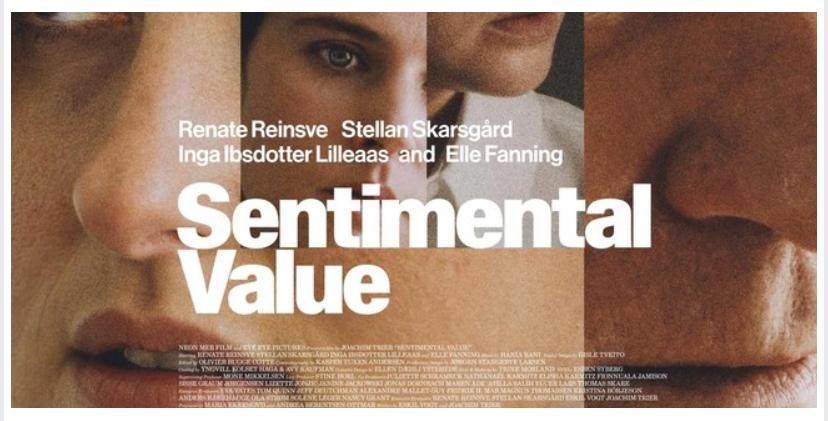
Directed by Joachim Trier; starring Stellan Skarsgård, Renate Reinsve, Inga Ibsdotter
Lilleaas, and Elle Fanning
Some films ask to be watched, while others ask to be felt. Joachim Trier’s Sentimental
Value lives firmly in the second category. The film is a rich, deeply human drama. About
ego, regret, creativity, and the fragile threads that bind families. Creates a world that
feels so real and so lived-in that you almost forget you’re watching a film. This film hit
me in ways I wasn’t prepared for. Not just emotionally, but truly spiritually. It’s about
art, sure; however, more importantly, it’s about the price of art.
The story centers on Gustav Borg, played with quiet devastation by Stellan Skarsgård.
Gustav, once a legendary filmmaker whose relevance has now dimmed. His films are
now regarded as relics of another era, and he acknowledges this. Like others who have
built their identity around their work, the thought of fading into artistic obscurity
terrifies him.
But that fear didn’t suddenly arrive. It has been growing for decades, right alongside
the emotional distance between him and his daughters, Nora (Renate Reinsve) and
Agnes (Inga Ibsdotter Lilleaas). Both women carry the scars of being raised by a father
who loved his art more than he loved staying present. Trier doesn’t exaggerate this
dynamic; he lets the wounds speak for themselves. Nora’s tension. Agnes’s guarded
calm. Gustav’s awkwardness around them. It’s all there, simmering quietly in every
interaction.
The film shifts when Rachel Kemp (Elle Fanning), a rising Hollywood star, stumbles
across Gustav’s early films at a festival retrospective. She becomes obsessed, not with
his reputation, but with his emotional language, his honesty, his risk-taking. Rachel
believes Gustav still has another masterpiece in him. And that belief, that spark, is the
match that lights the entire story on fire.
With her interest, Gustav sees an opportunity not only to revive his career but also to
tell the story he has avoided for years: a tragedy that happened inside the family home,
a loss so brutal that the Borgs have never fully spoken about it. The house, still
standing, still holding the air of their past, becomes a central character in the film, a
vessel of memory, grief, and unanswered questions.
But here’s where the emotional complexity kicks in: the role at the center of this new
script is offered to Rachel, even though the character is clearly inspired by Nora, the
daughter Gustav pushed away. Nora had been approached first and turned it down,
unable (or unwilling) to relive such a personal trauma through her father’s artistic lens.
Rachel, however, accepts, stepping into a character who is not hers to inhabit, at least
not without consequence.
Watching the three women, Nora, Agnes, and Rachel, circle Gustav feels like watching
tides shift. A different emotional temperature. Nora is a talented young stage actress
who guards herself the only way she can, with her ambition and independence. Agnes,
the daughter who left acting behind to build a quieter life. Now moves with a grounded
calm that hides her own grief. And Rachel is the outsider, eager, searching, drawn to a
family dynamic she doesn’t fully understand.
What gives Sentimental Value its heartbeat, though, is the way Trier treats these
relationships with such grace. There are no villains. No easy answers. Gustav is selfish,
but not cruel. Nora is hurt, but not brittle. Agnes is gentle, but not weak. Rachel is bold,
but not naive. Everyone is trying. Everyone is carrying something. Everyone is flawed.
And that is what makes the film feel painfully true.
Skarsgård gives one of the most vulnerable performances of his career. He plays Gustav
like a man who is both proud and ashamed, proud of his art, ashamed of the sacrifices
he demanded of others to make it. There are moments when his eyes alone tell a whole
story. Regret sits heavily on him, but so does longing. Longing for relevance and
longing for forgiveness and longing for the chance to rewrite the narrative of his life
before it closes.
Reinsve, once again, proves why she is one of the most compelling actors working
today. Her Nora is layered, fiery, wounded, and impossibly charismatic. She plays the
push and pull of daughterhood, wanting connection but fearing disappointment, with
precision.
Lilleaas is a revelation. Quiet, tender, deeply resonant. She doesn’t let Agnes fade into
the background; she brings strength to stillness and clarity to emotional restraint.
And Elle Fanning is the perfect counterweight, bright, hungry, and emotionally open in
a way that complicates the story in all the right ways.
The film’s emotional peak arrives when production on Gustav’s film begins. The past is
no longer abstract. Instead, it is being reenacted, rehearsed, and dissected in film. The
family confronts what happened in that house, not for the sake of the cinema, but also
for themselves. And Trier, with his unmistakable compassion, refuses to force a
reconciliation. Instead, Trier allows growth in small moments. A softened gaze, a
shared silence, a truth spoken out loud for the first time.
Ultimately, Sentimental Value asks two difficult questions:
Can a family heal when wounds are reopened?
and/or
Can a creator ever balance brilliance with responsibility?
The film doesn’t hand us answers, and that’s what makes it feel honest. Life rarely
gives closure. Sometimes all we get is a fragile understanding, and the courage to keep
trying.
This is Trier at his best: humane, poetic, sharp, and emotionally fearless. Trier respects
his audience enough to challenge us. To let us sit in discomfort. To see beauty in
broken connections.
Verdict:
Sentimental Value is a moving, beautifully crafted, and emotionally piercing work. A
story about art, regret, and the fragile hope that it’s never too late to reach for the
people you love. For me, this is one of Trier’s most mature, resonant films, anchored by
extraordinary performances and a story that lingers long after the credits.
“A filmmaker chasing his masterpiece. A family chasing what’s left of each
other.”
Score: 7.5/10 — intimate, generous, and unforgettable.