
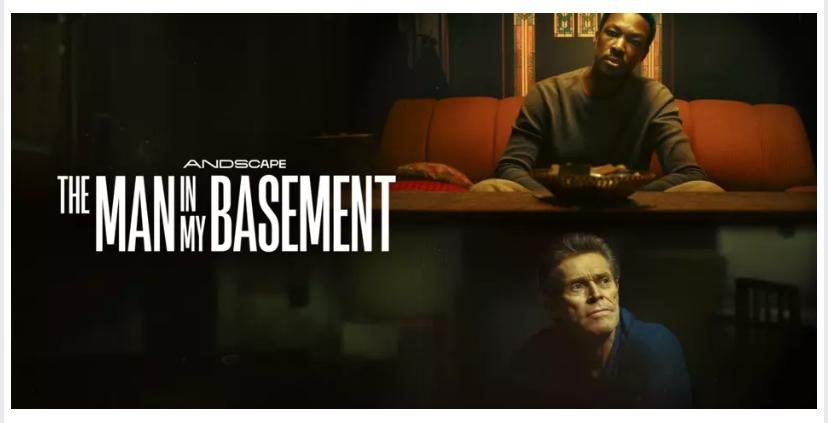
TIFF 2025 Review: “The Man in My Basement” Is a Masterclass in Psychological Tension
The Man in My Basement is the kind of film that poses a valuable yet straightforward
question: “What would you do for money?” and ultimately asks something far more
profound: “What is your soul worth?” The Man in My Basement made its screen debut
at TIFF 50. The film is a psychological thriller that instantly gripped you, proving that
great cinema doesn’t need explosions or spectacle to terrify; it just requires two brilliant
actors, one suffocating space, and a story that cuts straight to the bone.
Directed by Nadia Latif in her first feature-length film, and starring Corey Hawkins
and Willem Dafoe, The Man in My Basement is both haunting and hypnotic. Adapted
from Walter Mosley’s 2004 novel, Latif delivers a psychological chamber piece that feels
terrifyingly relevant in 2025—a meditation on race, guilt, and the unseen chains that
still bind people across generations.
A Simple Deal Turns Into a Nightmare
The story centers on Charles Blakey (Hawkins), a proud but struggling man living in
his late parents’ crumbling Long Island home. Burdened by debt and facing foreclosure,
Charles is desperate for a way out. Enter Anniston Bennet (Dafoe), a polite, eerily
calm white man who offers him a shocking deal: cash up front in exchange for renting
out Blakey’s basement, for the entire summer.
At first, it seems like a strange but harmless arrangement. But Bennet’s request is
anything but typical. He brings in his own furniture, installs locks from the inside, and
sets up cameras. Then comes the real twist: he doesn’t want to live in the basement;
he wants to be imprisoned there.
What unfolds next is a tense, psychological cat-and-mouse game that leaves the
audience on the edge of their seats. Each scene is tighter, darker, and more revealing
than the last. Hawkins and Dafoe are electric together, two actors at the top of their
game, feeding off each other’s intensity in a space barely big enough for both to
breathe.
Power, Race, and the Illusion of Control
Latif’s film thrives on the shifting power dynamic between the two men. Blakey may
technically be the landlord, but from the moment Bennet steps into the house, it’s clear
who holds the power. Bennet toys with him, not through violence, but through intellect
and manipulation. Every conversation is a trap. Every question feels like a confession
waiting to happen.
As Bennet’s true motives begin to surface, The Man in My Basement transforms into a
dark allegory of racial trauma and generational guilt. It becomes clear that this was no
accident that Bennet, a wealthy white man, seeks punishment in the home of a
struggling Black man whose ancestors were once enslaved. The film plays with that
inversion brilliantly, asking whether redemption is even possible when history itself
refuses to stay buried.
The basement, stark and windowless, becomes both a literal and symbolic space, a
purgatory where past sins are confronted, and where the lines between victim and
villain blur. By the end, Latif leaves you questioning who’s truly imprisoned: the man in
the basement, or the one upstairs.
Corey Hawkins and Willem Dafoe Deliver a Masterclass
Corey Hawkins has quietly built one of the most impressive acting resumes in
Hollywood, from Straight Outta Compton to BlacKkKlansman to The Tragedy of
Macbeth. However, this might be his finest work yet. His performance is raw, wounded,
and deeply human. You feel every ounce of his pride, his desperation, his anger
simmering beneath the surface. Hawkins doesn’t just play a man pushed to the
edge—he makes you believe you’re standing there with him.
And then there’s Willem Dafoe. What can you even say about Dafoe that hasn’t already
been said? He’s one of cinema’s most significant risk-takers, and as Bennet, he’s
absolutely chilling. There’s a perverse calm in his performance. An unnerving politeness
masking something unholy. He speaks softly, almost kindly, while dismantling Blakey’s
psyche one piece at a time.
Together, the two men create a volatile chemistry that feels almost theatrical. Every
exchange is loaded with subtext, every silence screams louder than words. It’s a film
that lives and dies on its performances, and here, both actors deliver career-defining
work.
The Director’s Vision
Latif uses her theatre training to create a taut and unsettling experience between
Hawkins and Defoe. Bringing a stage-like intimacy to the film and transforming a limited
space into an emotional pressure point. Latif has the camera linger uncomfortably long,
forcing you to sit in moments of silence and dread. The lighting, muted and
claustrophobic, gives everything a suffocating realism.
But what really sets The Man in My Basement apart is Latif’s refusal to give easy
answers. She doesn’t spell out Bennet’s motives, nor does she offer redemption for
Blakey. Instead, she lets the tension fester, daring you to fill in the blanks.
TIFF’s Audience Response
At TIFF 50, the film drew long lines and even more extended conversations. Some
praised its courage and complexity, while others found it too unsettling. But no one
walked out unmoved. Some compared it to the psychological intensity of Get Out
and The Lighthouse. It’s easy to see why. Like those films, The Man in My Basement
uses genre as a mirror, reflecting our collective unease about power, race, and identity.
Audiences especially praised the final 20 minutes, an almost unbearably tense sequence
that flips every assumption you’ve made about both characters. It’s one of those
endings that sparks arguments in the lobby afterward, which is precisely what great
cinema should do.
The Verdict
The Man in My Basement is not an easy watch, but it is considered an essential one. It’s
a story in itself about the debt we owe to our pasts. The weight of the guilt we carry,
and, of course, the cost of pretending we can escape either.
Hauntingly shot, brilliantly acted, and deeply provocative, it’s the kind of film that
doesn’t just entertain. It forces you to think, to feel, and to confront uncomfortable
truths long after the credits roll.
If there’s any justice, this film will follow the same awards-season trajectory as its
thematic cousin, Get Out. But even if it doesn’t, The Man in My Basement has already
earned something more valuable: it’s one of TIFF 2025’s most talked-about and
unforgettable films.